
Analytics
Track your trading performance with comprehensive analytics. Monitor key metrics, break results down by symbol, strategy and direction, and export any view to Excel or CSV.
Introduction
Analytics reads the closed trade history from your trading account and turns it into the numbers that tell you whether a system is working: profit factor, win rate, expectancy, drawdown, and the same figures broken down per symbol, per strategy and per direction.
The data comes from the account itself, not from your signals. Manual trades, trades from other tools and TradeSgnl trades all appear side by side.
What your plan includes
Analytics comes in two levels.
Basic Analytics starts at the Starter plan. It covers the four headline metric cards, the Balance & Equity chart, and the four key indicators below it.
Detailed Analytics starts at the Advanced plan. It adds everything else on the page: the Summary, History and Calendar tabs, the Direction, Symbol and Strategy breakdowns, and the filter bar with Export.
The number of accounts you can monitor at once also follows your plan: Starter covers 1 account, Advanced 3, and Professional 10.
Getting Started
Connect your account. If the account runs the TradeSgnl EA, use the latest version, available from the Download page in your dashboard.
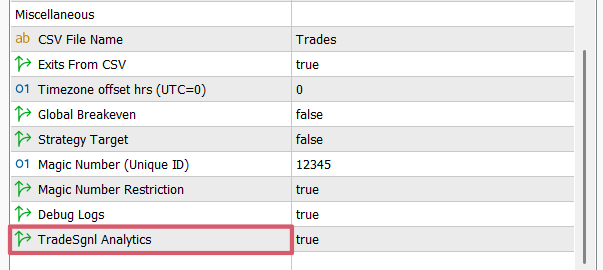
Check Analytics is enabled. Open the EA settings panel and scroll to the Miscellaneous group at the bottom. Enable TradeSgnl Analytics is on by default, so in most cases there is nothing to change.
Open the Analytics page. Your first upload starts as soon as the account connects. On an account with a long history it can take a few minutes for everything to process.
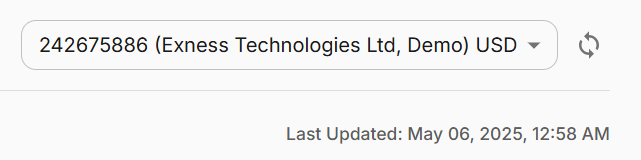
Pick an account. The switcher in the top right lists every account that has uploaded analytics, with the broker, the last four digits of the account number, and whether it is Demo or Live.
Accounts that are no longer connected stay in the list and keep their history, marked Offline. Connected accounts are sorted to the top. Your choice is remembered between visits, and it is carried in the page URL, so a link to a specific account reopens on that account.
Keeping the data fresh
Next to the account switcher you will see when the account last uploaded, for example Updated 1 minute ago. Past the first day this becomes a date instead.
The refresh button beside it asks the EA to send a new report and updates the page when it arrives. It only works while that account is online, since the request goes to the running terminal. For an offline account you are looking at the last report it sent before it disconnected.
Analytics does not poll in the background. The page loads what is stored when you open it, and refreshes when you ask it to.
The headline metrics
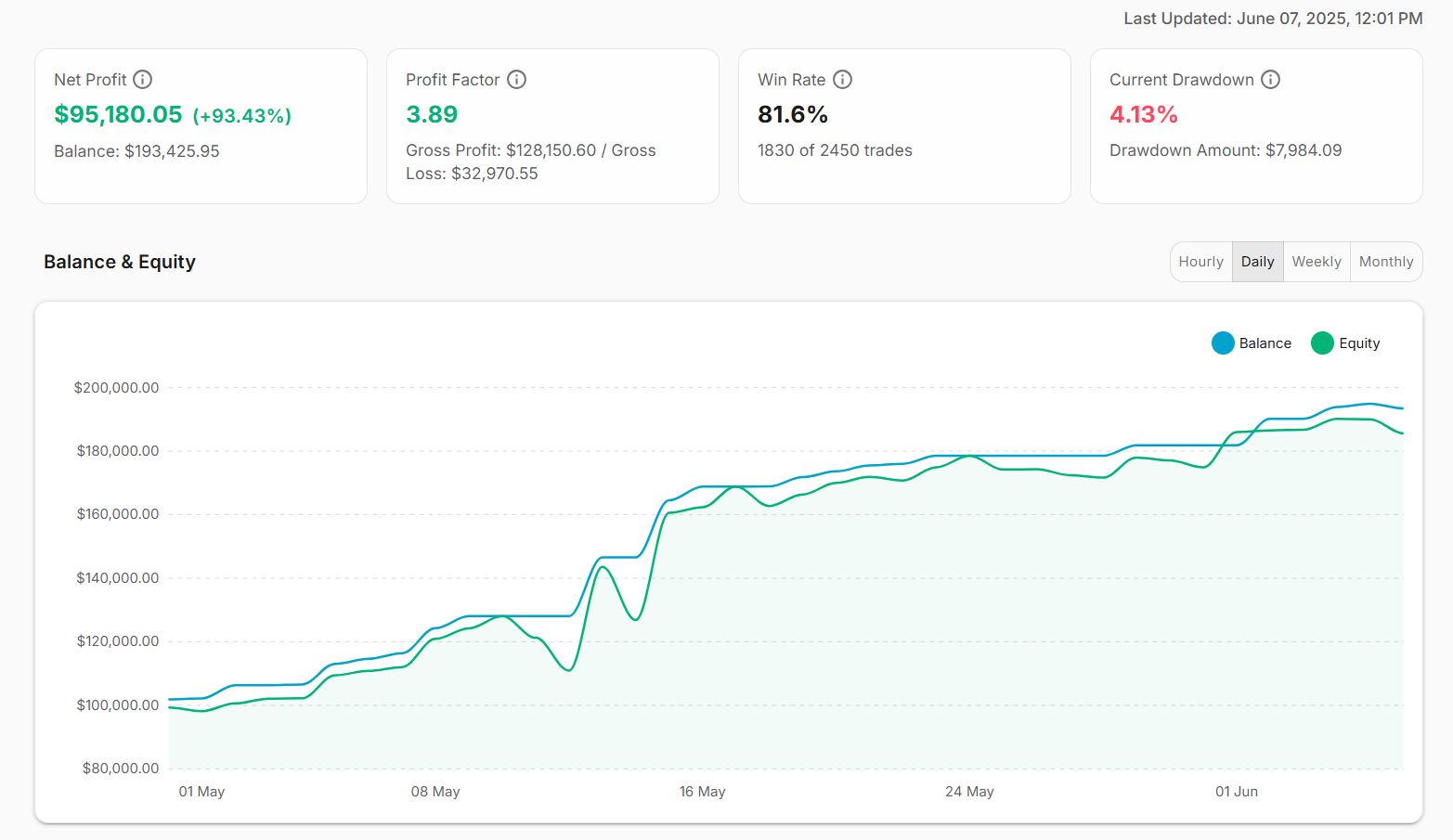
Four cards sit above the chart and four below it.
| Metric | What it tells you |
|---|---|
| Net Profit | Total profit or loss after all fees and costs, with the percentage change and your current balance |
| Profit Factor | Gross profit divided by gross loss. Above 1 means the account is profitable overall |
| Win Rate | Share of trades that closed in profit, with the raw count behind it |
| Current Drawdown | The gap between balance and equity right now, which is your open unrealised loss |
| Win/Loss Ratio | Winning trades divided by losing trades. Above 1 means more winners than losers |
| Risk/Reward Ratio | Average win divided by average loss |
| Maximum Drawdown | The largest peak-to-trough decline the account has been through |
| Expectancy | Average profit or loss per trade. The single number that says whether the system pays |
Win rate and reward-to-risk are worth reading together rather than separately. A 47% win rate looks unremarkable on its own, but paired with a 2.24 risk/reward it produces a healthy expectancy. Understanding profitability below works through why.
Balance & Equity
The chart plots balance against equity over time. The Hourly, Daily and Monthly buttons change how the points are grouped: hourly for reading a single session closely, monthly for seeing the shape of a year.
Where the two lines separate, you are holding open positions. Equity above balance means those positions are in profit.
Trading Statistics
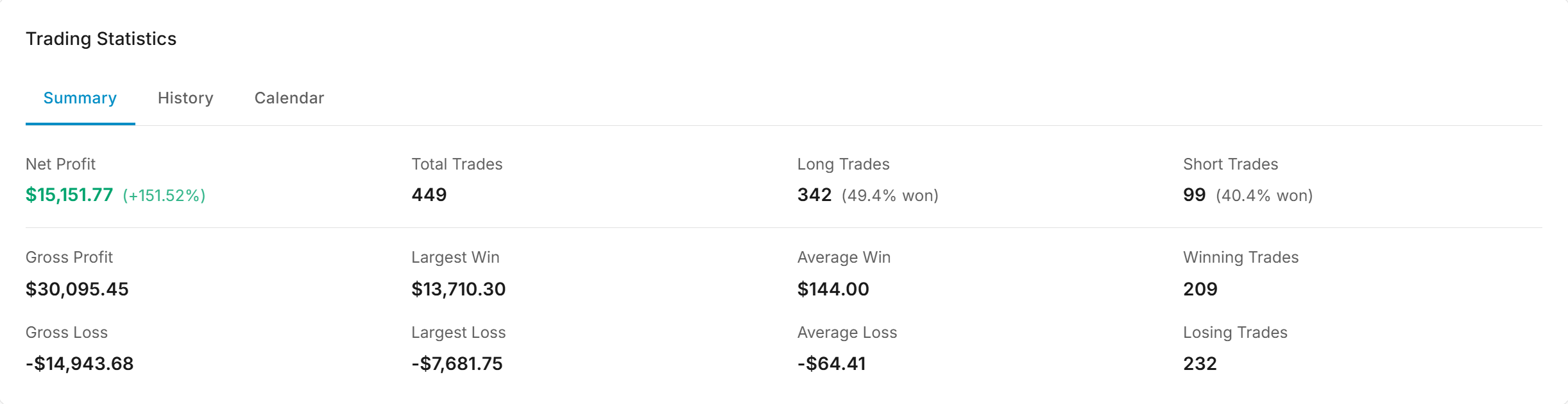
The Trading Statistics card holds three tabs.
Summary
The full breakdown of wins and losses, including the long and short split with a win rate for each, your largest single win and loss, and gross figures before fees.
History
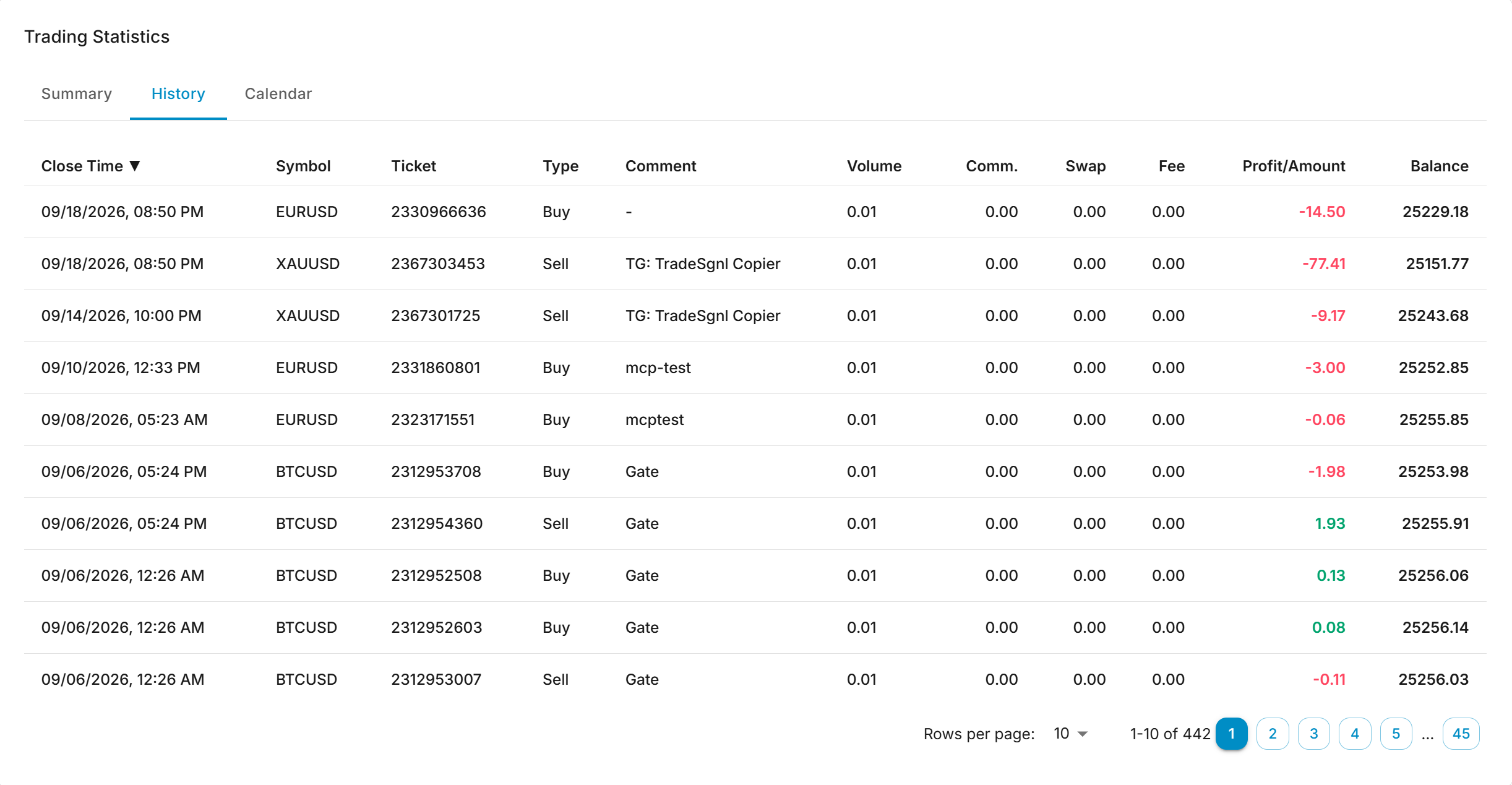
Every closed trade, newest first. Columns cover close time, symbol, ticket, type, comment, volume, commission, swap, fee, profit and the running account balance after that trade.
Click Close Time to reverse the order, and set Rows per page to 5, 10, 25 or 50.
Calendar
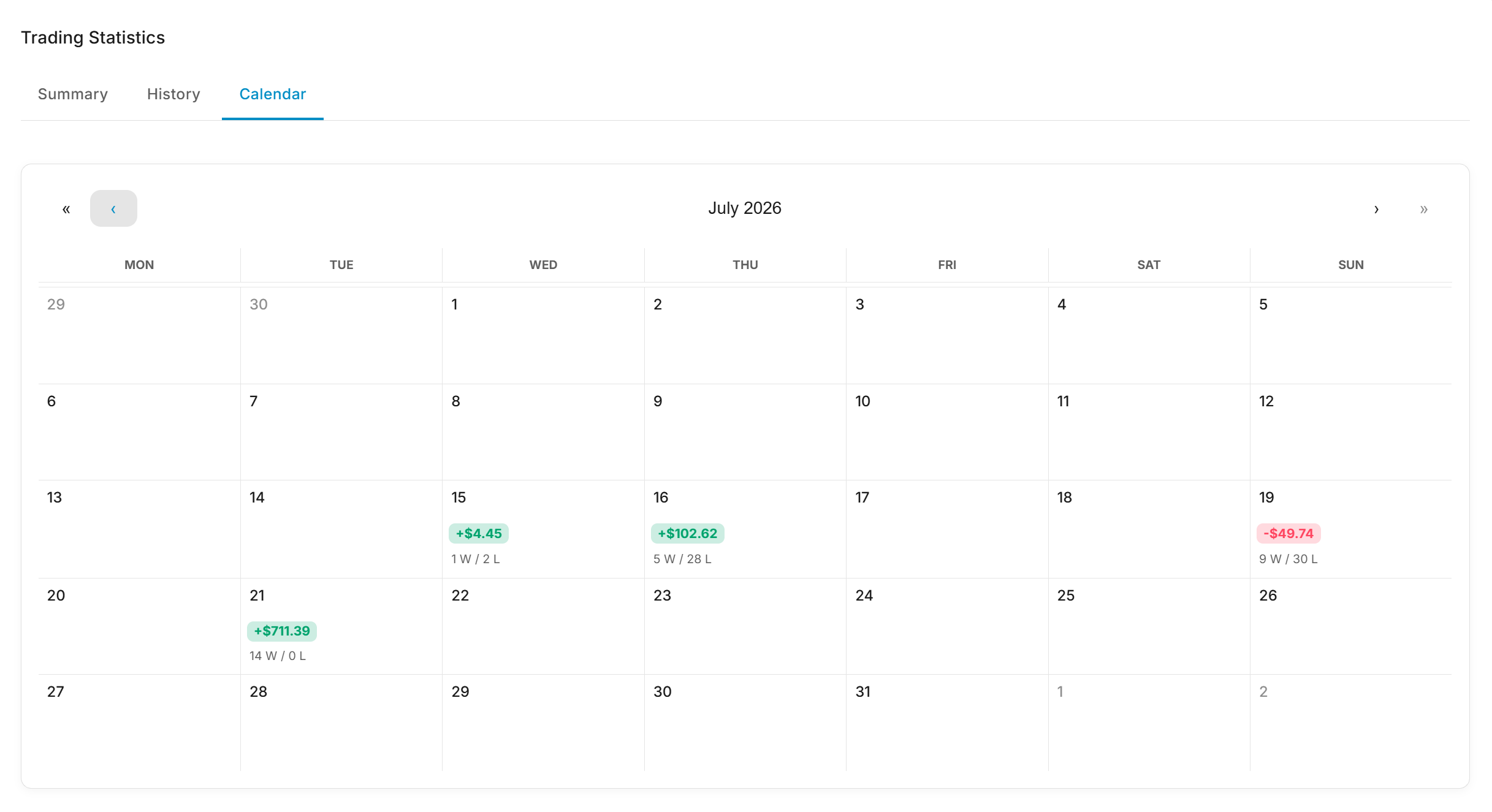
A month view with the net profit or loss for each trading day and the win/loss count underneath. Days you did not trade stay empty. Use the arrows to step through months, or the double arrows to jump a year.
This is the quickest way to spot a pattern the totals bury, like one bad session paying for itself across the rest of the month.
Performance Breakdown
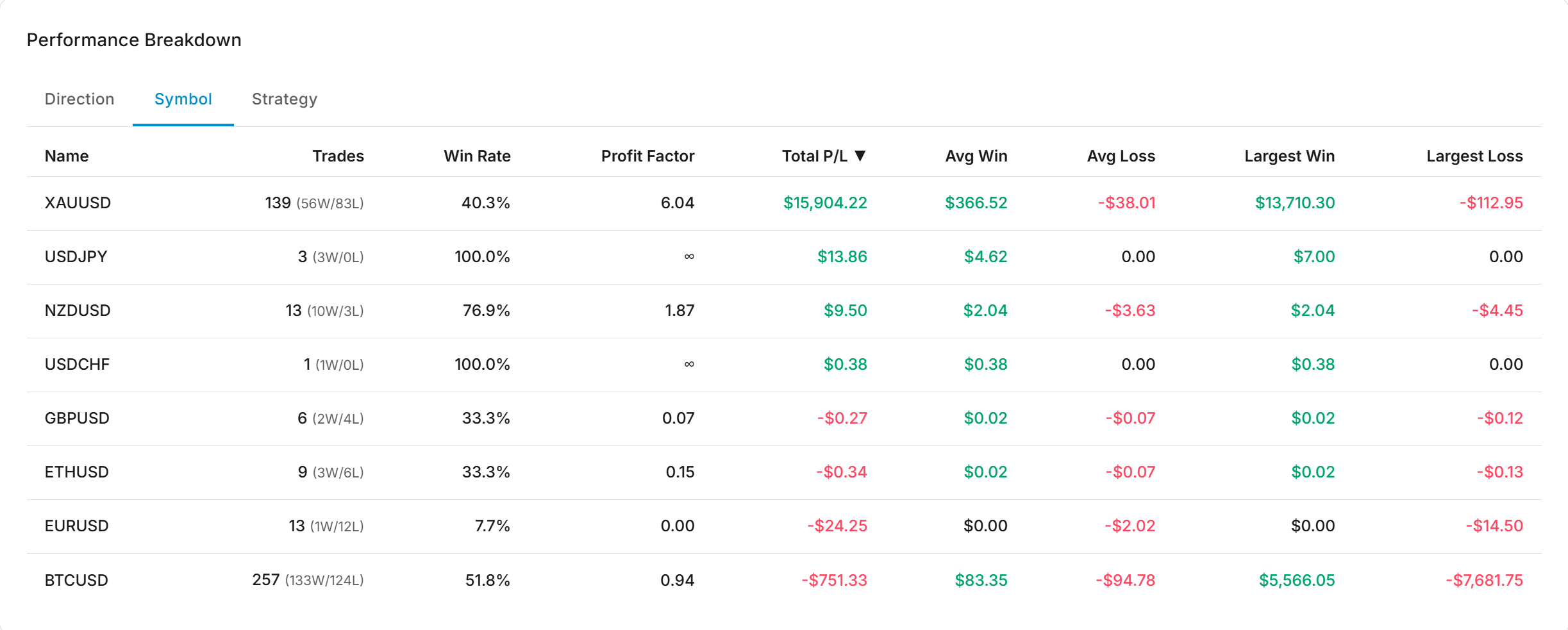
The same statistics, cut three ways. Every column header sorts, so you can rank by profit factor, win rate or total P/L rather than reading down the list.
Direction
Long against short. Traders are often much better at one than the other without realising it, and this is the table that shows it.

Symbol
Every instrument you have traded on the account. Useful for finding the pair that quietly funds the account, and the one quietly draining it.
Strategy
Trades grouped by the comment= value in the signal that placed them. That parameter is already how TradeSgnl separates one strategy from another, so every strategy you run on the account gets its own row here and can be compared against the rest.
Trades that arrived without a comment, including most manual trades, are grouped as No Strategy.
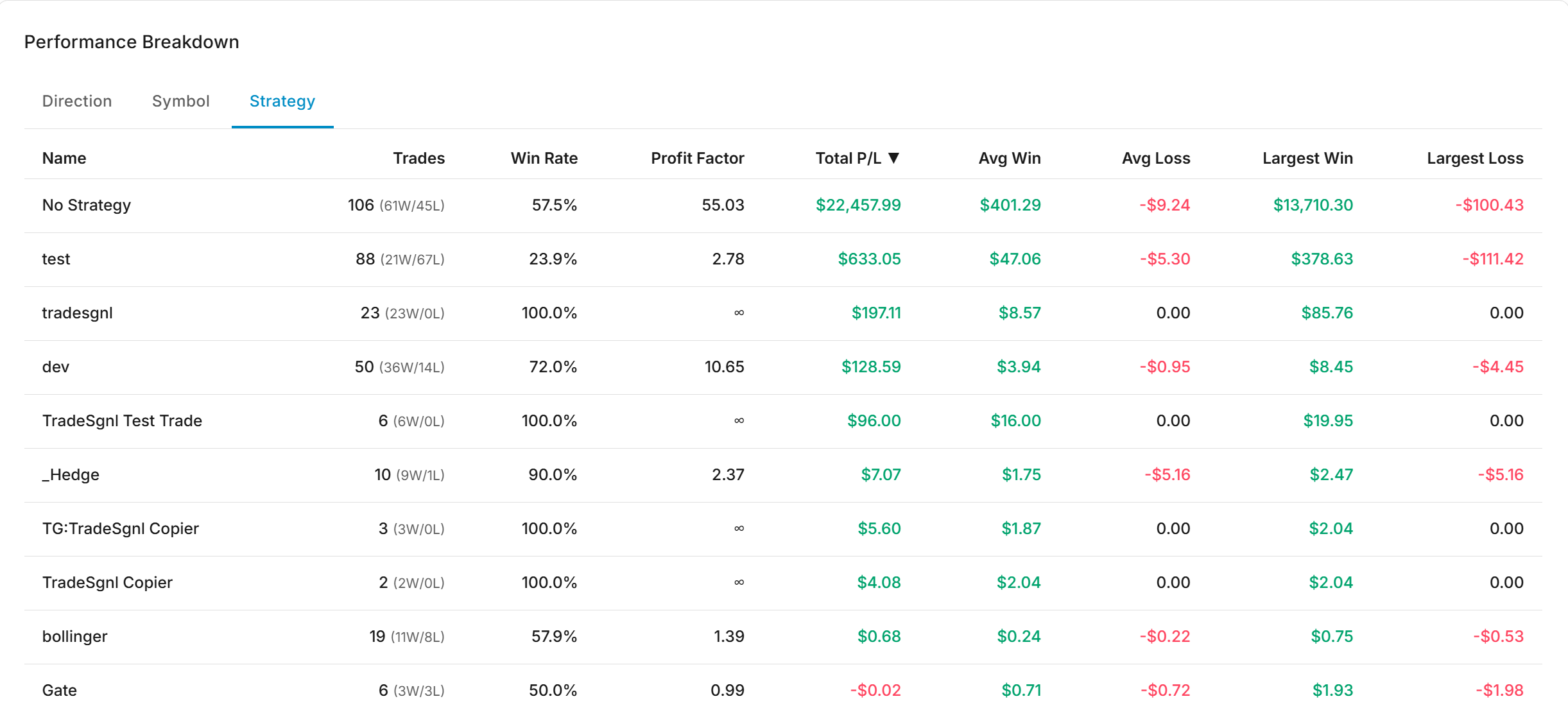
Setting comment= on your signals is what makes this table worth reading. See Multiple Strategies for how the parameter works and what else it controls.
Filtering and Export
The bar above the metrics narrows every part of the page at once. The cards, the chart, the statistics tabs and the breakdowns all recalculate against the slice you select.
- Date range. Presets for the last 7, 30 or 90 days, the last 12 months, last month, this month, this year and all time, plus a calendar for a custom range.
- Symbols. Any combination of instruments. Each option shows how many trades it holds.
- Strategies. The same, by trade comment.
- Direction. Long, short or both.
A Clear button appears once a filter is applied, and applied filters are highlighted so you can tell at a glance what is narrowing the page.

Export takes whatever is currently on screen:
- Excel (.xlsx) gives you six sheets: Summary, Trades, Symbols, Strategies, Direction and Daily.
- CSV gives you the trades only.
Filtering and Export are part of Detailed Analytics, from the Advanced plan up.
FAQ
Understanding Profitability Across Trading Systems
A common misconception is that profitable trading requires both high win rates and high reward-to-risk ratios. In reality, understanding the relationship between these factors is key to building sustainable trading systems.
Relationship between reward-to-risk ratio and breakeven win rate
| Reward-to-Risk | Breakeven Win Rate |
|---|---|
| 0.5 | 67% |
| 1 | 50% |
| 2 | 33% |
| 3 | 25% |
| 5 | 17% |
| 10 | 9% |
For example, a system with a 2:1 reward-to-risk ratio only needs a 33% win rate to break even. At a 40% win rate, the same system becomes solidly profitable over time.
To evaluate your trading system's true potential, calculate its expectancy, the average profit or loss you can expect per trade. This is the figure the dashboard shows in the Expectancy card.
Expectancy Formula
Expectancy = (Win Rate × Average Win) − (Loss Rate × Average Loss)Where:
- Win Rate: The percentage of trades you win.
- Loss Rate: The percentage of trades you lose, or (1 - Win Rate).
- Average Win: The average profit from winning trades.
- Average Loss: The average loss from losing trades.
Example Calculation
If your win rate is 40% (0.4), your loss rate is 60% (0.6), your average win is $100, and your average loss is $50:
Expectancy = (0.4 × 100) − (0.6 × 50)
Expectancy = 40 − 30 = $10
With a positive expectancy of $10 per trade, this system is profitable in the long run despite having more losing trades than winning ones.
Analytics tracks these metrics across all your accounts, so you can tune entry timing, exits and position sizing against real results rather than guesswork.
Sgnl AI
Ask Sgnl AI about your trades, accounts and setup in plain English. It reads your own results, checks why a signal didn't trade, writes alert messages, and answers any question about TradeSgnl.
Market Analyst
A conviction-gated market analyst inside your portal. Pick any symbol and a trading style, and the AI reads live market structure, levels, momentum, and volatility, then either lays out a trade scenario with an invalidation level or tells you to stand aside.